Rankings and Results


It is of paramount importance to the University of Pécs that our university proves its excellence year after year in international higher education rankings, achieving high positions on numerous lists, which reflect the educational and research performance of our institution as well as its international embeddedness. 

These results confirm all the work that our teachers, researchers, students, and staff do together to strengthen the university's reputation and professional standards.  

Our goal is to move even further ahead in the international arena through continuous development and innovation, thereby strengthening the reputation and attractiveness of our university among current and future students and partners.

Below you will find further information on the rankings that are important to our university.


Times Higher Education (hereinafter referred to as THE) is an international ranking provider based in the United Kingdom. Our university is listed in THE's World University Rankings and in several subject rankings. 


THE World University Ranking has 17 indicators divided into 5 major groups. The figure shows that the 5 major groups examine Teaching (29.5%) and Research (29.5%) activities, Research Quality (30%), International Outlook (7.5%), and Industry (4%). The individual indicators are based on the results of questionnaires sent to the scientific community, the Scopus bibliographic database, and institutional data reporting. Each criterion is weighted differently. 
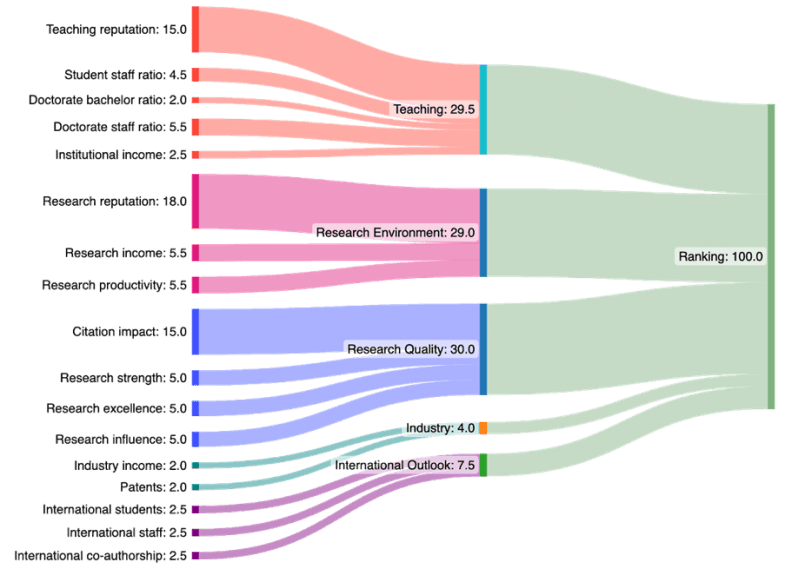

(Source: World University Rankings 2025: methodology)


THE provides rankings for 11 subject areas: Arts & Humanities, Business & Economics, Computer Science, Education, Engineering, Law, Life Sciences, Medical & Health, Physical Sciences, Psychology, Social Sciences.  

It examines the same 17 indicators as the World University Ranking, but with different weightings. The rankings take bibliometric indicators from the Scopus bibliographic database. Journals listed in Scopus are classified by field of science, and only articles and references belonging to a given field of science are counted in the rankings for each field. 

On the 2025 list, UP appears on 7 of the 11 field lists: Business & Economics, Engineering, Life Sciences, Medical & Health, Physical Sciences, Psychology, and Social Sciences.


Quacquarelli Symonds (hereinafter: QS) is an international ranking service provider based in the United Kingdom. UP is listed in the QS World University Rankings, the World University Rankings: Europe, and several World University Rankings By Subject.

You can read more about the QS Sustainability Rankings here. 


The QS World University Ranking ranks universities according to 10 indicators within 5 lenses. The individual indicators are based on questionnaire results, the Scopus bibliographic database, and institutional data reporting. Each criterion is weighted differently. The weighting of the indicators can be found on this website.


Experts at Quacquarelli Symonds (QS) ranked nearly 700 universities in around 40 European countries based on 12 criteria in five lenses. Among other things, they compared institutions based on indicators such as the research ecosystem, post-university career opportunities, and sustainability.

In 2025, the University of Pécs ranked 314th in the international ranking, which is a very respectable position, and it also managed to improve on its previous ranking. 


QS provides rankings for five major subject areas: Arts and Humanities, Engineering and Technology, Life Sciences & Medicine, Natural Sciences, and Social Sciences & Management. Within these, there are 53 sub-field rankings. The lists are ranked solely on the basis of scores derived from scientometric and questionnaire-based popularity surveys; higher education institutions do not provide separate data.  

In 2025, within the Engineering category, UP is ranked in Petroleum Engineering, and within the Life Sciences & Medicine category, it is ranked in Agriculture & Forestry, Biological Sciences, and Medicine. The rankings by scientific field can be viewed here 


The Shanghai Ranking (officially known as the Academic Ranking of World Universities, or ARWU for short) is a ranking created by a Chinese research group. Its original purpose was to compare the performance of Chinese universities internationally, but today it is used as a global ranking. The Shanghai Ranking primarily evaluates universities based on research performance. It does not take into account, for example, the quality of education or student satisfaction.

UP ranked 401-500 in the human biology category in 2025. Further information can be found here.


The aim of UI GreenMetric is to evaluate and compare the environmental performance, sustainability initiatives, and green infrastructure of the universities surveyed. The ranking indicators all examine the issue of sustainability (e.g., Waste and Water Management, Infrastructure, or the number and impact of Sustainability Courses and Research). 

In 2025, our university ranked 25th among 1,477 universities in 95 countries, achieving the highest ranking among Hungarian universities. 


RUR is a Russian ranking system that aims to evaluate universities proportionally, taking into account not only their research activities but also their other tasks. The ranking uses 20 indicators, which are divided into the following four categories: education (40%), research (40%), international diversity (10%), and financial sustainability (10%).

In 2025, our university ranked 377th overall and 216th in terms of education quality among more than a thousand universities. You can view our university's other rankings here. 


For further information, please contact our staff at authorsupport@lib.pte.hu or call (72) 501-600/28042.